History of the Général Jean-Victor Allard Armoury in Trois-Rivières
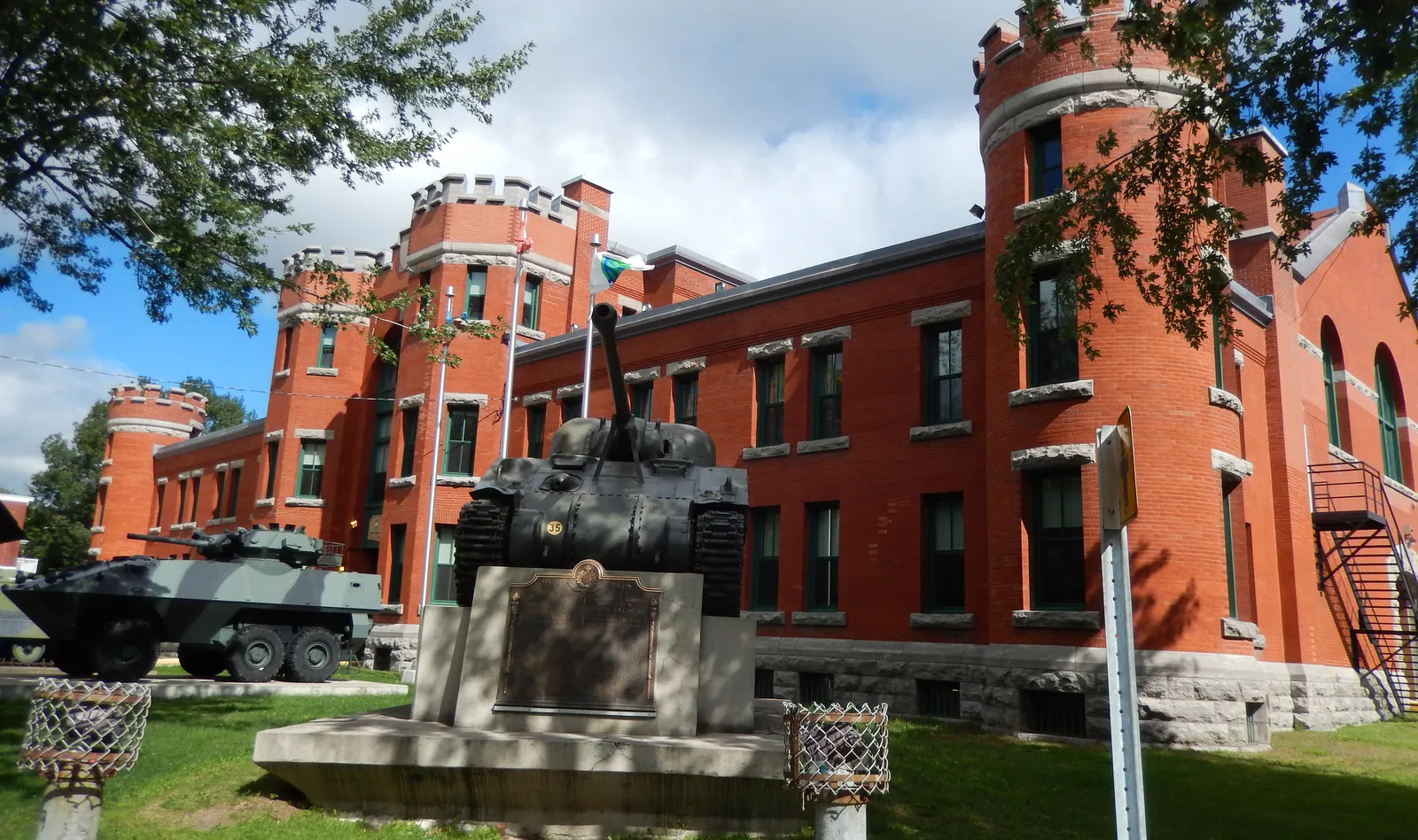
A brick fortress in the heart of Trois-Rivières
The Général Jean-Victor Allard Armoury, long known simply as the Trois-Rivières armoury, was built in 1905–1906 at 574 Saint-François-Xavier Street. The home of the 12e Régiment blindé du Canada, it has been a recognized federal heritage building since 1991 and has borne the name of General Jean Victor Allard since November 2000.
More than a century after it was built, the building is still very much alive. It houses the 12e RBC (Milice), the Trois-Rivières Military Museum and, every Wednesday evening, the cadets of 2671 Army Cadet Corps and 772 Vanier Squadron.
An armoury born of militia reform
In the early 20th century, Canada reformed and expanded its volunteer militia. Under Frederick Borden, Minister of Militia and Defence from 1896 to 1911, who had the Militia Act revised in 1904, the federal government launched a major armoury-building program: about a hundred were built across the country, under the direction of the Department of Public Works and the Department of Militia and Defence.
In Trois-Rivières, the regiment of the day, the 86th Three Rivers Regiment, asked for a drill hall. In 1904, the Ursuline nuns sold the land, at the corner of Saint-François-Xavier and Sainte-Geneviève streets. Tenders were called in early 1905 and the contract went to builder Joseph Bourque of Hull. Construction began in 1905 and the armoury was completed in the fall of 1906.
The plans were prepared by the Chief Architect's Branch of the Department of Public Works, under architect Thomas W. Fuller, who oversaw the design and construction of every drill hall produced by the branch from 1902 until the end of the First World War. The Trois-Rivières armoury is a "Class B" armoury built to his standard design.
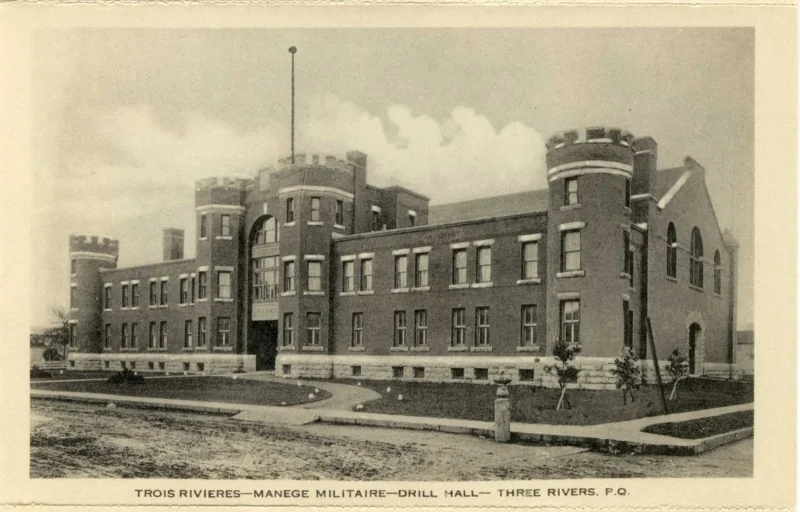
Fortress architecture
Like many armouries of its time, the Trois-Rivières armoury looks like a castle. Parks Canada describes it as "evocative of a medieval fortress as evidenced in the solid brick construction, stone detailing and the monumental façade, crenellated turrets and troop doorways."
- a red brick façade, trimmed with limestone for the base, window sills, string courses and crenellations;
- four crenellated towers: two round towers at the ends of the façade and two polygonal towers flanking the entrance;
- large wooden troop doors under a stone arch, topped by a wide round-headed window, and a stone shield at the entrance;
- a stacked-cannonball detail on the gable's corner buttress;
- a vast drill hall free of columns, under a gable roof carried by steel trusses.
Parks Canada also highlights the building's place in its neighbourhood: set on a prominent corner, it fits the residential character of the area and is a conspicuous and familiar building within the community.
A place of remembrance
For more than a century, the armoury has been the home of the Trois-Rivières regiment, today the 12e Régiment blindé du Canada. Until the late 1930s, when the city still lacked a large hall, public meetings were also held at the armoury.
On November 13, 1955, the veterans' association of the 12th Canadian Armoured Regiment unveiled a memorial in front of the armoury to the members of the regiment who died in the Second World War: a Sherman tank named "Cathy", put in place the year before, with a plaque bearing their names.
The Général Jean-Victor Allard Armoury
The armoury held a special place in the life of General Jean Victor Allard. It was here, among other places, that he began his militia career with the Three Rivers Regiment in 1933. After becoming the first French-Canadian Chief of the Defence Staff, then Colonel of the 12e RBC from 1969 to 1979, he came back to the armoury every Tuesday evening after he retired to play cards with old comrades-in-arms.
At the Remembrance Day ceremony in November 2000, the 12e RBC (Milice) unveiled a plaque renaming the building the Manège Général-Jean-Victor-Allard, in the presence of the general's daughters. "Naming the armoury after him is not just symbolic; it was his due," said the regiment's commanding officer, Lieutenant-Colonel Jean-Marc Hamelin (translated from French).
A federal heritage building
On April 18, 1991, the armoury was recognized as a federal heritage building for its historical, architectural and environmental value. According to Parks Canada, it is closely associated with Canada's pre-First World War armoury building campaign and the reform and expansion of the volunteer militia, and it reflects the importance of Trois-Rivières as a centre of military activity. It is also listed in Quebec's Répertoire du patrimoine culturel. In 2015, the federal government announced a $750,000 investment to replace its roof and carry out other repairs.
The Trois-Rivières Military Museum
The armoury is also home to the Trois-Rivières Military Museum, the museum of the 12e RBC. Its permanent exhibition, laid out around the drill hall, on the mezzanine and in the Amiens lounge, features the regiment's uniforms, equipment, weapons, medals and honour cases, alongside seasonal exhibitions. Check the museum's website (in French) for opening hours.
In the heart of downtown
The armoury stands in downtown Trois-Rivières, in the Sainte-Cécile district, a residential area close to several major institutions. The Séminaire Saint-Joseph, Sainte-Cécile Church, the courthouse, the Musée POP and the Cathedral of the Assumption are a few minutes' walk away, as are Old Trois-Rivières and its Des Ursulines Street.
Key dates
- 1904 – The Militia Act is revised; the Ursulines sell the land for the future armoury.
- Early 1905 – Tenders are called; the contract goes to builder Joseph Bourque.
- Fall 1906 – Construction of the armoury is completed.
- 1933 – Jean Victor Allard becomes an officer of the Three Rivers Regiment.
- September 1, 1939 – The Trois-Rivières regiment is mobilized.
- November 13, 1955 – The Sherman tank "Cathy" memorial is unveiled.
- May 2, 1968 – The regiment becomes the 12e Régiment blindé du Canada.
- April 18, 1991 – Recognized as a federal heritage building.
- November 2000 – The "Manège Général-Jean-Victor-Allard" plaque is unveiled.
- 2015 – A $750,000 federal investment for the roof and other repairs.
- 2021 – 150th anniversary of the 12e RBC.
Sources
This page is based on the following sources:
Parks Canada, Directory of Federal Heritage Designations: "Armoury", Trois-Rivières
Canadian Register of Historic Places: Armoury, Trois-Rivières
Répertoire du patrimoine culturel du Québec: Manège militaire de Trois-Rivières (in French)
Veterans Affairs Canada, Général Jean-Victor Allard Armoury
Veterans Affairs Canada, Three Rivers Regiment memorial
La Tourelle, 12e RBC newsletter, 2001, no. 1, plaque unveiling (archived PDF, in French)
Government of Canada, infrastructure investments in Trois-Rivières (July 2015, in French)
Patrimoine trifluvien, no. 19, built heritage chronology (2009, PDF, in French)
Patrimoine trifluvien, no. 2 (1992, PDF, in French)
Images
Photo of the armoury in 2013: By Fralambert — Own work, CC BY-SA 3.0, via Wikimedia Commons
Postcard "Trois-Rivières — Manège militaire — Drill Hall", May 9, 1907: unknown author, public domain, via Wikimedia Commons
Keep exploring
2671 Army Cadet Corps
772 Vanier Squadron
The 12e Régiment blindé du Canada
General Jean Victor Allard
The Freedom of the City
Georges Vanier
Our history
Come and see the armoury from the inside
The cadets of the 2671 and the 772 meet there every Wednesday evening, from September to May. It's free, and the uniform is provided!
Join us →